The Ultimate DTF Transfer Sizing and Placements Guide
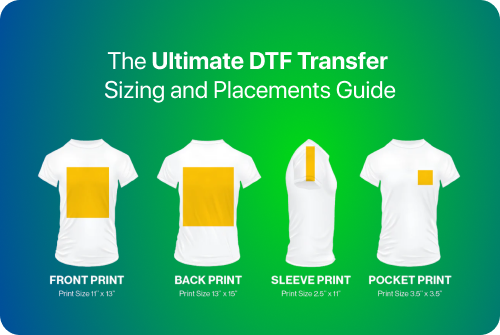
DTF transfer sizing and placement refers to selecting the right print dimensions and exact positioning on a garment so your design looks balanced, readable, and on brand.
Measure width first, then height, so type and logos read cleanly across the chest. Use centerline, collar seam, and side seams as anchor points, and keep consistent distances below the collar for repeatable results. Scale for garment category and body size, adjust for fabric stretch, and protect fine detail when reducing dtf transfer sizes for youth, women’s cuts, and performance tees. For hard goods, plan artwork with smaller strokes and smooth edges, then apply with uv dtf transfers.
Short on time, start with the charts, then fine tune with the quick rules below. This guide keeps settings simple, so your team can choose sizes fast and press with consistency.
Use the shop’s dtf transfer size chart to pick a starting width for each placement, then save presets in your dtf transfer size guide for tees, hoodies, crews, and tanks. Confirm platen heat with a surface thermometer, square the garment to the centerline, and press dtf transfers within the recommended temperature and dwell window. When you schedule runs or order dtf transfers wholesale, note final dtf transfer sizes on the work order to reduce reprints and keep every batch looking uniform.
Introduction
You get better prints when size and position fit the garment, not the mockup. Choose a size that matches body area and fabric stretch, then place it using collar, centerline, and side seams as anchors. Lock in repeatable rules so every press operator achieves the same look.
This guide includes a practical bold-only keyword approach, charts for common placements, and field tested tips that reduce wasted sheets and reprints.
Heat Transfer Terminology
- Print size
The measured width and height of your design, used to pick from the dtf transfer size chart or to set a custom cut.
- Standard size
A commonly accepted dimension for a specific location, for example 11 in wide full front on an adult tee, used in any dtf transfer size guide.
- Anchor point
A fixed spot on the garment that keeps placement consistent, most used anchors are center front and distance below the collar.
- Dwell time
The time under heat and pressure while you press dtf transfers, follow the manufacturer’s window.
- Temperature
The heat setting at the platen during pressing, verify with a surface thermometer for accuracy.
- Teflon Paper
A reusable sheet that protects the print surface, use when the fabric is delicate or to prevent shine.
- Pressure
The force applied during the press cycle, consistent pressure improves bond and hand feel.
- Cooling Time
The time before peeling or re-pressing, use the recommended cool or warm peel approach to protect edges.
DTF Transfer Sizing & Placement
Provide direct answers first. Use these standard sizes for fast setup, then adjust to fit your artwork proportions. The table shows common ranges that work on most cotton, cotton blends, and performance tees.
A. Quick Size Table, Adult, Youth, Toddler
- Left Chest
- Adult, 3.5–4.5 in x 3–4 in
- Youth, 3–3.75 in x 2.5–3.5 in
- Toddler, 2.5–3 in x 2–3 in
- Center Chest
- Adult, 8–10 in x 3–5 in
- Youth, 7–9 in x 3–4 in
- Toddler, 6–7 in x 2.5–3.5 in
- Full Front
- Adult, 10–12 in x 12–14 in
- Youth, 9–11 in x 10–12 in
- Toddler, 7–9 in x 8–10 in
- Sleeve (left or right)
- Adult, 2.5–3.5 in x 2–3 in
- Youth, 2–3 in x 1.5–2.5 in
- Toddler, 1.5–2.5 in x 1.25–2 in
- Collar / Small Upper Back
- Adult, 3–4.5 in x 1–2 in
- Youth, 2.5–3.5 in x 1–1.75 in
- Toddler, 2–3 in x 0.75–1.5 in
- Upper Back
- Adult, 10–12 in x 3–5 in
- Youth, 8–10 in x 3–4 in
- Toddler, 6–8 in x 2.5–3.5 in
- Full Back
- Adult, 11–13 in x 12–14 in
- Youth, 9–11 in x 10–12 in
- Toddler, 7–9 in x 8–10 in
- Oversize Front/Back
- Adult, 13–14 in x 15–17 in
- Youth, 11–12 in x 13–15 in
- Toddler, 9–10 in x 11–12 in
Use the dtf transfer size chart above to match design and garment. Pair it with the placement distances below.
B. Placement Distances
- Left Chest: 7–9 in down from the high point shoulder, 3–4 in from center, align with side seam for a straight vertical reference.
- Center Chest: 2–3 in below collar on adult, 1.5–2.5 in on youth, scale distance as size decreases.
- Full Front: 2–3 in below collar, center on the body midline, keep hems clear by at least 2 in.
- Sleeve: Center between the seam and hem, rotate to follow sleeve grain, 1–1.5 in above hem.
- Collar or Small Upper Back: 1–2 in below the collar seam, centered on the neck label.
- Upper Back Name Bars: 3–4 in tall characters for adults, 2.5–3.5 in for youth, align to shoulder blades.
- Full Back and Oversize: 2–3 in below collar, center vertically between collar and mid back.
Tip, if a design feels too tall, reduce height before width to preserve readability across chest curvature.
Expert Tips for Optimizing DTF Transfer Sizing
Give the fastest wins first. Start with width rules, then adjust height. Width reads first when someone faces the wearer.
- Lead with width: For most adult tees, 11 in wide full front reads well without crowding seams.
- Mind body sizes: Size up one inch on 2XL and above, size down one inch on XS and youth.
- Respect fabric stretch: On lightweight triblends, avoid oversize heights that can distort on the torso.
- Use anchor points: Mark centerlines with a folding press or a light crease, center both garment and transfer.
- Proof at scale: Print a paper template at actual size, hold the garment to test proportions.
- Protect fine details: Increase minimum stroke to 1.5 pt when you scale down.
- Batch consistency: Save presets in your dtf transfer size guide for each product line, then train your press team to use them.
Pre Press Checklist
- Lint roll garment, pre press 3–5 seconds to clear moisture.
- Verify platen heat with an external thermometer.
- Align using center and collar distances.
- Press dtf transfers within recommended temp and dwell window, apply even pressure.
- Cool according to peel type, post press 3–5 seconds if needed for finish.
Scaling Rules That Travel
- Hoodies run shorter in the visible chest area because of the pocket and hood, reduce height by 0.5–1 in for center chest.
- Women’s fitted tees often need a 0.5–1 in reduction in width for full fronts, keep important text above the bust line.
- Long sleeve sleeve prints can go taller, increase length by 0.5–1 in to match the longer canvas.
When to break the chart
- Tall artwork with a stacked logo can run 12–13 in high on adults if the width stays at 9–10 in, maintain 2–3 in clearance from collar and hem.
- Badge style left chest with heavy detail can stretch to 4.75 in wide on large sizes, only if legibility remains crisp at arm’s length.
Common DTF Transfer Sizing Mistakes to Avoid
Direct answers first, avoid crowding the collar, avoid over scaling on small sizes, and avoid ignoring fabric type.
- Too close to the collar: Keep at least 2 in on adult tees, kids can sit at 1.5–2 in, crowded prints feel tight.
- Oversized on youth: If adult width is 11 in, youth should be 8–9 in, preserve breathing room.
- Ignoring garment shrink and stretch: Pre wash test one garment from each blank brand, recheck placement after dry.
- No centerline: Eyeballing causes drift, crease the tee down the middle and fold the transfer to mark center.
- One size fits all: Save separate presets for tees, hoodies, crews, and tanks, use your dtf transfer size chart to switch quickly.
- Skipping press validation: A five degree heat drop across the platen changes peel behavior, measure, then adjust.
Conclusion
Right size, right spot, better result. Use the tables to pick starting dimensions, then adjust for garment type and wearer size. Choose anchor points that your whole shop can apply the same way, add width first, and protect fine detail when you scale. Standardize these rules in your dtf transfer size guide, your operators will press faster, your prints will match, and your clients will notice the consistent quality.
If you need bulk options, order dtf transfers wholesale for scale, try uv dtf transfers for hard goods, and always press dtf transfers with verified heat and pressure for a clean finish.
FAQs
What size DTF transfer for an adult shirt?
Full fronts at 10–12 in wide fit most adults, reduce width to 9–10 in if the design is very tall. Left chest works at 3.5–4.5 in wide.
What size are DTF sheets?
Common sheets are A4 and A3, many shops also run gang sheets by custom width. Use your dtf transfer sizes to plan efficient gang layouts.
Can I use the same transfer size for youth and adult shirts?
Use separate sizes. Scale youth down 15–25 percent in width from adult, recheck height for legibility.
Can I use the same transfer size for youth and adult shirts?
Use separate sizes. Scale youth down 15–25 percent in width from adult, recheck height for legibility.
How far from the collar should I place a chest print?
Keep 2–3 in for adult center chest, 1.5–2.5 in for youth. For collar back tags, sit 1–2 in below the seam.
Do I need to resize transfers for hoodies vs. t-shirts?
Yes. Hoodies often need slightly shorter heights to avoid the pocket and hood. Reduce height by 0.5–1 in and recheck the look.